October 23, 2026
Pour Over Basics
Pour over is the simplest manual method a home brewer can learn, and the most instructive. It asks for little — a cone, a paper filter, a kettle, and a mug or carafe — yet it places the whole brew in the brewer's hands. No machine sets the timing. Once understood, it becomes a disciplined morning practice.
Pourover bed fairly quickly, and a finer grind gives it more surface area to work with in that short contact. Too coarse, and the water rushes through, leaving the cup thin and sour. Too fine, and the water stalls, the bed clogs, and the cup turns bitter and heavy. Adjust one variable at a time: a little finer if the cup is sour and thin, a little coarser if it is bitter and slow to drain.
Water should be just below boiling, around 200 degrees Fahrenheit. Without a temperature-controlled kettle, boil the water and let it rest about thirty seconds before pouring. Boiling water can scorch the flavour; water too cool will not draw out enough flavour, and the cup will taste flat. Just below boiling is the temperature middle ground.
A sound starting ratio is one part coffee to sixteen parts water by weight — roughly two tablespoons of whole bean coffee, ground, for every six ounces of water for a single mug, double it for two. This is a beginning, not a law. If the cup tastes weak, use a little more coffee next time; if too strong, a little less. Taste, not a chart, is the final judge.
First, place the filter in the cone and rinse it with hot water, discarding the rinse water. This removes any papery taste and warms the brewer and vessel, so the finished coffee stays hot.
Second, add the ground coffee and shake the cone gently so the bed is level. A level bed matters: water takes the easiest path, and an uneven bed invites it to channel down one side while leaving the rest under-extracted.
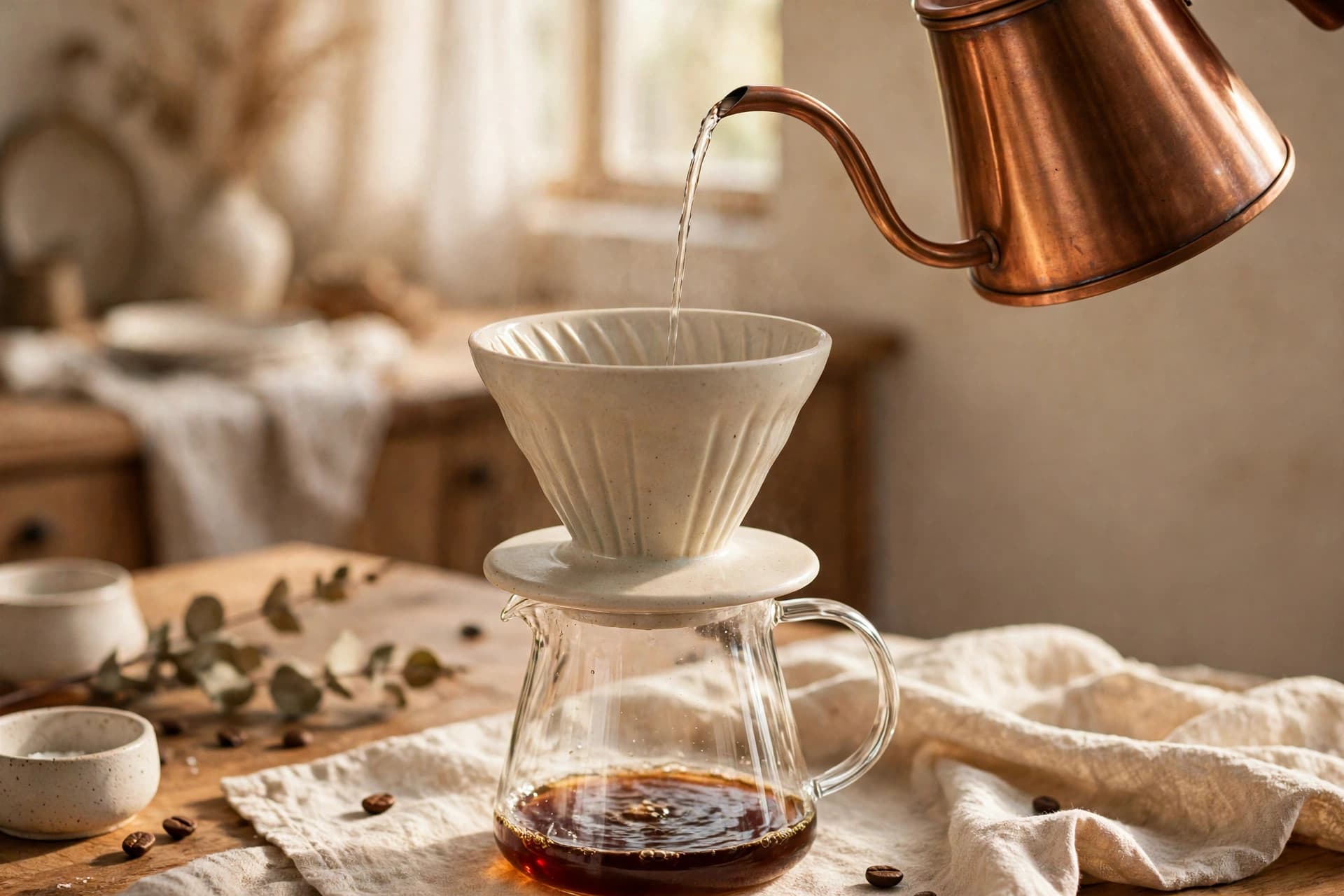
Third, the bloom — the step most often skipped, and the one that makes the largest difference. Pour just enough hot water to wet all the grounds, about twice the weight of the coffee, and stop for thirty to forty-five seconds. Trapped gas escapes and the bed puffs up slightly; released during the main pour instead, it would push back against the water and make extraction uneven. With coffee roasted fresh to order, the bloom is lively, a plain sign of freshness.
Fourth, the main pour. Pour slowly, in a slow spiral, beginning in the centre and moving outward, then back toward the centre, keeping the water level steady and the stream thin. The spiral wets the grounds evenly; pouring all the water in one spot over-extracts that spot while leaving dry edges sour. Two or three gentle stages, letting the water drain a little between pours, are often easier to control than one long pour.
A single mug usually takes two and a half to three and a half minutes from first pour to last drip. A much faster drain suggests too coarse a grind; a much slower one, too fine. When dripping slows to an occasional drip, remove the cone, swirl the mug gently, and taste.
Four faults account for most muddy pour over: pouring too fast and hard in the centre, which stirs up fine grounds and clouds the cup; skipping the bloom, which leaves gas to disrupt the main pour; an uneven bed, which sends water down a shortcut; and stale, pre-ground coffee, which no technique can rescue. Pour over is honest, showing exactly what the coffee tastes like. Fresh whole bean coffee, ground just before brewing, makes the greatest difference of all. At Holy Roastin' Empire, every bag is roasted fresh to order.
Brew as usual, but change only one thing: rinse the filter, bloom for thirty seconds, and pour in a slow spiral. Do not change the coffee, grind, or ratio at the same time. Then ask: is the cup sweet, bright, or heavy? Clean, or muddy? Pleasant after swallowing, or harsh? If it tastes cleaner than yesterday, the lesson is kept. If it still tastes muddy, try a slightly finer grind, or a slower pour. One variable at a time teaches more than any new gadget can.

The takeaway is the discipline of the method itself: one small pour change can clean up a muddy cup. Slow down, bloom, and pour evenly, and let the coffee show what it can do.